Decision-Making Cost, Efficiency & Optimization
4/2/20263 min read


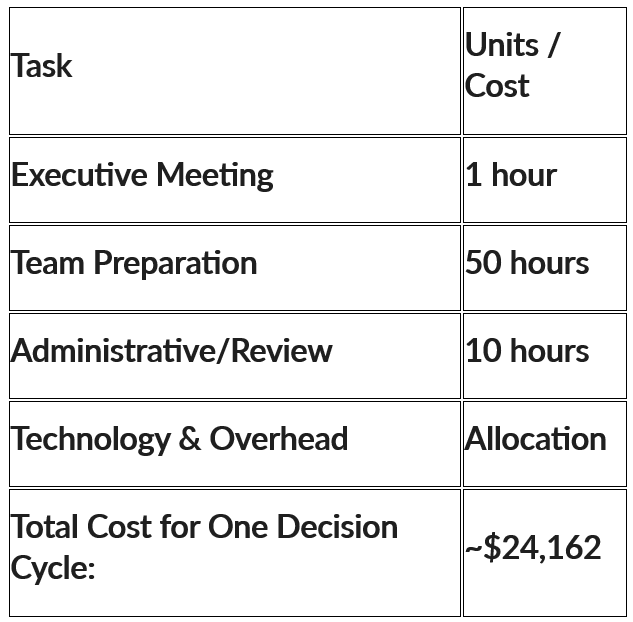
In reality, a "Big" decision usually takes 3 to 5 such sessions, meaning a single major strategic pivot at a major company can easily cost the organization over $100,000 in internal labor alone before a single dollar is actually spent on the project itself.
Related Expenses
The cost isn't just the hour spent in the room. Major decisions incur "shadow costs":
Prep Work (The "Multiplier"): For every 1 hour the C-Suite meets, mid-level managers usually spend roughly 40–60 combined hours preparing data decks, financial models, and risk assessments.
Opportunity Cost: While these leaders are in this room, they are not addressing other fires or revenue-generating opportunities.
Software & Tools: Large-scale analytics (e.g., Snowflake, specialized ERPs) used to generate the decision data.
Legal/Consulting Fees: Major strategic moves often involve outside counsel or "Big Four" consultants for due diligence.
If we factor in the additional expenses, an important decision in a large organization could cost up to $350,000 by the time the final decision is made. On the other hand, when a large company makes a "bad" decision, the cost isn't just the lost meeting time—it’s a compounding disaster of fines, remediation, and lost market value. An example – the financial fallout at a major North American bank recently, resulting in a regulatory fine, imposition of an Asset Cap and remediation costs.
Root Cause Analysis (The 5 Whys)
The following analysis traces the symptoms of inefficiency back to the systemic failure:
1. Symptom: Organizations waste money and time on slow decisions.
2. Why? Reliance on informal discussions and intuition over structured process.
3. Why? No simple problem-solving framework exists that all stakeholders trust.
4. Why? Decision habits evolved in silos without clear ownership of the "process of deciding."
5. Root Cause: Leadership treats decision-making as an informal habit rather than a managed process. There is a lack of awareness regarding the "hidden cost" of bad processes.
The Remedy: Shift away from opinion-based reasoning.
Proposed Strategic Solutions
Solution: The Low-Risk Pilot & Workflow Design. Design a simple decision-making toolkit with a pilot client. By running several real-world, high-value decisions through the system, we can create a side-by-side comparison of:
Cycle Time: Before vs. After.
Confidence Levels: Stakeholder trust in the result.
Resource Drain: Total man-hours spent per decision.
Impact of Inaction
If this remains unaddressed, the "ripple effect" includes:
Financial Leakage: Continued overspending on analysis-paralysis.
Missed Opportunities: Competitors with faster decision cycles will outpace the client.
Erosion of Trust: Stakeholders lose faith in the quality and transparency of strategic choices.
Conclusion
The transition from an "informal habit" to a "managed process" is a complex challenge requiring behavioral change. However, by making the cost of waste visible through data, we can motivate organizations to adopt a system that makes their work faster, safer, and more economical.
Decision-Making - Cost, Efficiency & Optimization
Executive Summary
Current operations by large organizations are characterized by slow, mostly intuition-driven decision processes that consume excessive financial and human resources.
Problem Definition
The Core Issue: Organizations for the most part are over-investing money, time, and internal resources in unstructured decision-making processes. These ad hoc methods lead to "decision fatigue," repeated meetings, and costly rework.
Problem Statement: "Organizations lack a deliberately designed decision-making process; consequently, legacy habits systematically waste capacity and obscure the value of adopting a more rigorous, structured system."
Investigation Scope
Diagnosing current decision workflows, quantifying wasted resources, and piloting a structured problem-solving system to demonstrate efficiency.
Cost of a Major High-Value Decision
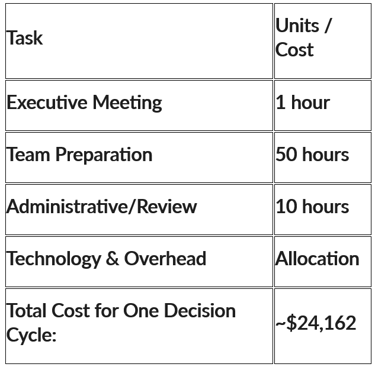
Total Approximate Cost of the Decision. If we calculate the input for a single major strategic decision (which usually requires a series of meetings and extensive prep), it looks like this: