
From Reacting to Predicting: Building a "Decision System" for Massive Construction Projects
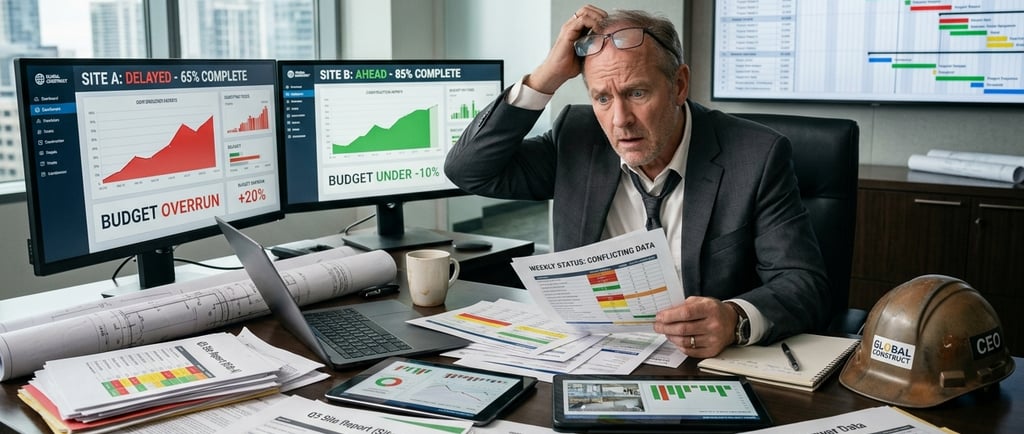
As mega-projects in Canada and the U.S. grow larger, the way leaders make decisions hasn't kept up. While the projects are massive, the systems used to manage them are often manual, disconnected, and disorganized. The internal "operating spine"—the digital path that carries facts from the construction site to the executive office—is no longer strong enough to handle the complexity of the work.
4/30/20262 min read
From Reacting to Predicting: Building a "Decision System" for Massive Construction Projects
As mega-projects in Canada and the U.S. grow larger, the way leaders make decisions hasn't kept up. While the projects are massive, the systems used to manage them are often manual, disconnected, and disorganized. The internal "operating spine"—the digital path that carries facts from the construction site to the executive office—is no longer strong enough to handle the complexity of the work.
The Problem: Managing in the Dark
In most companies today, what happens on-site is moved into reporting systems like SAP or P6 through slow, manual workarounds. This creates "Decision Latency," where it can take 14 days for a major field issue to show up on an executive's radar.
By the time leadership sees the data, it is often too late to fix the problem easily, and money has already been lost. Managers end up making billion-dollar decisions based on old, incomplete information. If this isn't fixed, projects will continue to go over budget, clients will lose trust, and leaders will spend all their time "firefighting" emergencies.
The Solution: A Reliable Decision Spine
Construction firms need a Decision OS—a standardized digital system that connects field tools (like Procore) with financial and scheduling tools (SAP and P6) in real-time.
● Treat Data as a Key Product: Assign a specific leader (a Product Owner) to manage how data flows through the company. Their job is to serve both the Superintendent in the field (making data entry easy) and the Executive (making sure the data is useful for big decisions).
● The "Cold Weather" Field Test: Software must work in the real world. Field leads should simplify interfaces until they can be used quickly and easily—possibly even with work gloves on—to ensure that more than 90% of data is entered every day.
● The "Shadow Plan" for Speed: Don't wait for a slow, company-wide IT overhaul. Instead, use a small "Special Ops" team to follow one major project for 30 days. Use the clean, automated data from that one project to show everyone else how much better things can work.
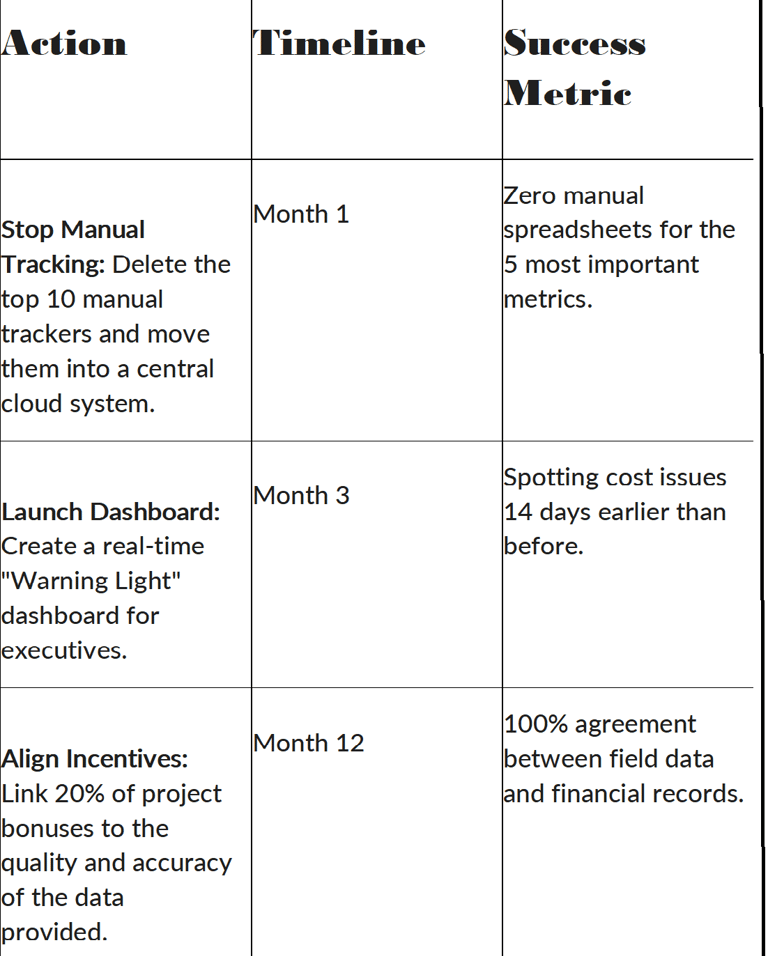
Action Plan
The immediate goal is to stop relying on manual work and align everyone’s goals:
The Bottom Line
The Metric that Moves: Margin Predictability. By building this system, companies can expect to see 15–20% fewer "surprise losses" within a year. The ultimate goal is to reach at least 95% forecast accuracy and make sure leaders see field data in less than 24 hours. This shifts the company from reacting to problems to mastering them before they happen.